Want Your Board to Deliver on the Gala?
Feed the Monkey Brain

Want Your Board to Deliver on the Gala?
Feed the Monkey Brain.
The neuroscience of why real problem-solving — not just another gala update — is what motivates your Board to raise money.
Last month, I made the point that fundraising is a team sport — and that your Board belongs on the field, not the sidelines. I promised you HOW to get them involved. Well, here it is, after sixty seconds of neuroscience, because it changes everything.
Why does your Board member want to design the invitation?
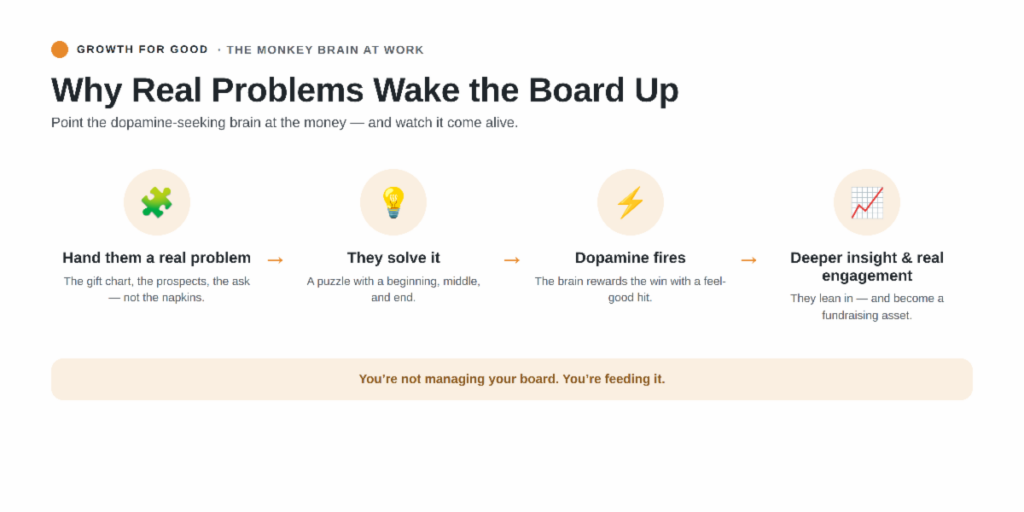
It’s not because they’re desperate to tap into their inner artist and pick a font. It’s because designing feels like helping. It’s a tiny problem, a puzzle with a beginning, a middle, and an end. The moment they solve it, their brain hands over a little treat.
That treat is dopamine.
We are, after all, primates. Well-dressed primates, but primates just the same. And the primate brain lights up with dopamine – when it solves a problem. Your Board members fussing over the napkins aren’t being difficult. They are searching for that sweet neurochemical.
Here’s what may not be obvious. When a Board Member reaches for the small stuff, they are not trying to meddle. It’s just a brain hungry for a problem, grabbing at the nearest one. The invitation design (or any of the zillion other gala details) is simply the nearest one.
So, if they want problems to solve, hand them some — the real ones. The fundraising work. The gift chart. The prospects. The asks that actually fill the room. Point that same dopamine-seeking brain at the money. Then watch as your Board Members stop discussing the signature cocktail and become valuable fundraising assets.
Here is another reason dopamine matters. Neuroscience has shown that problem-solving and the brain chemicals it unleashes unlock the brain’s capacity for deeper insights. You are not managing your Board gala committee. You are upgrading it.
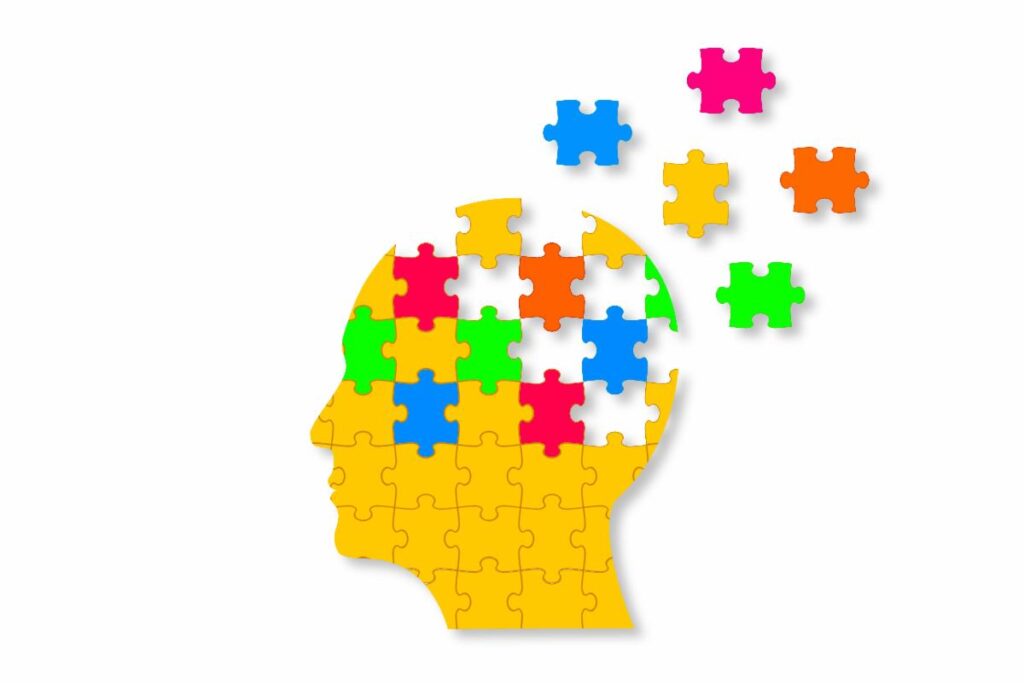
Give them the puzzle. Feed the brain.
Involve your Board in problem-solving — it’s pure neuroscience.
Your most powerful engagement tool costs nothing: don’t hand your Board the finished strategy. Hand them the partially finished one. To jump in and fix something is their primate instinct.
That’s the why. The how is the rest of this piece.
Start here. Get the gala committee in a room and put the real questions on the table. What does a wildly successful gala look like next year? How many new donors? What’s the goal, and why do we believe we can hit it? Let them argue it out, define success in their own words, and defend it to the full Board.
Do not let them skip to the “how.” The magic is in wrestling with the what, the why, but most importantly — the HOW. When a Board sets its own goals, and the steps included to get there, two things happen at once: they buy in completely — it’s their plan now, not yours — and their brains light up like an old pinball machine, because you’ve handed them the biggest, juiciest problem in the building. They have the horsepower; the trick is simply where you direct it.
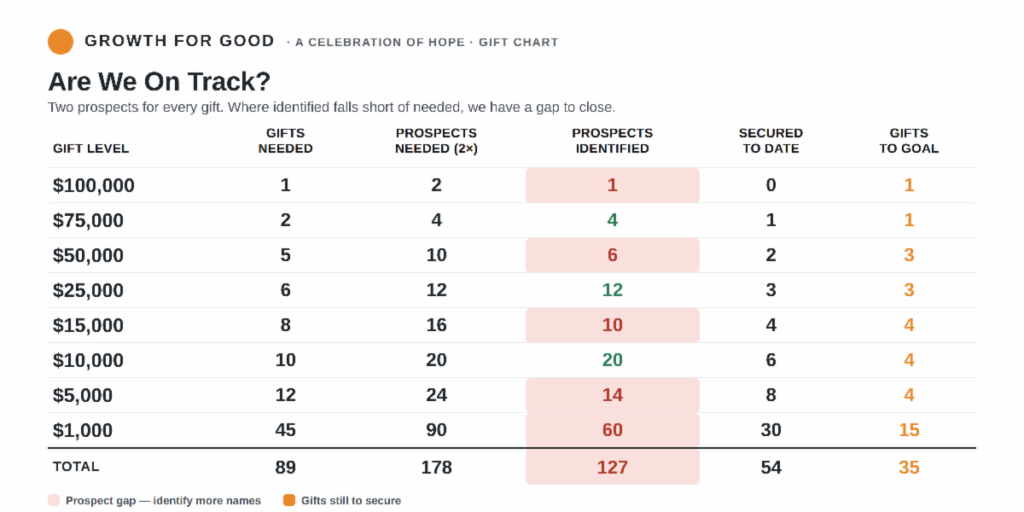
Hand them the gift chart.
If you do one concrete thing to engage a subset of your Board in gala planning, do this. Put a (partially filled-in) gift chart on the table and give them the puzzle.
Set the goal and build the chart to reach it. Don’t arrive with a finished number; task them with setting it, building the gift chart, which is, in fact, your business plan. Pre-fill last year’s gifts by level, so every renewal is staring the room in the face. Because you need two prospects for every gift of $2,500 and up, ask them to name those prospects. Wherever the names run out, you’ve found your gap, which is precisely what the honoree and dinner chair exist to close.
This becomes your baseline for every future meeting. You will constantly be asking: Where are we against the plan? Who has reached out to whom? Where were we this time last year? What’s the gap? (This is what my last post meant by treating your gala like a data set: last year’s dates become this year’s benchmarks.) Be transparent, present the problem, and watch the Board rise to the occasion to solve it. The wisdom of the crowd is real.
It’s not luck; it is simple algebra.
To raise $1.5M you need one sponsor at $100K, two at $75K, five at $50K, and so on down the chart; so who do we renew, and how many new names must we find? The monkey brain adores algebra. It adores hitting the number even more. And luck has never been a dependable strategy.
Click HERE to download our blank Excel gift chart template.
Find the sponsors who fill the top of the chart first
Big money asks first. Start with the sponsors you already have. Fill in last year’s names, level by level — because it’s business school 101: retaining a customer is always easier than cultivating a new one. Who at the top can be renewed with one well-placed call? And who on the Board can make that call, or follow up on it? Renewals are the fastest, cheapest path to money on the whole chart. Make these asks first — as soon as you can.
Honorees are how you land new sponsors, so this is where the Board’s little black book earns its keep. A good honoree is a person, not an institution, and the ask is intentional: before anyone says yes, they agree to work their network toward the goal. (As I said in my last blog: you’re after cash, not cachet.)
Here’s the move most people run backward. Don’t ask the Board “Who should we honor?” and wait to see what floats up. Start with the ideal target: you decide who you want — the developer, the chief executive, the donor with the deep bench and the deeper Rolodex.
Then work out who on your Board actually knows (not my dentist knows a guy).
Use your resources—one executive director I admire quietly checks LinkedIn the moment a name comes up to see who’s already connected. Then, engineer the introduction: brief your Board member, hand them the words, and let them make the ask. Target first, connection second, orchestrated ask third. That’s how a client landed an honoree that brought four tables, and pushed an event past $1.3 million.
Remind the Board, endlessly, that a gala is people-to-people — roughly 99% of guests come to their first one because someone they know asked them to.
Marketing is lovely, but it is not the driver.
Dinner chairs work the same way. The host committee is just arithmetic: need to sell 160 tickets and want the committee to move half? Recruit 20 members, each buying two and selling two. Let them solve that equation with you — that’s the dopamine hit. So is “we’re at 16 members and 60 tickets.”
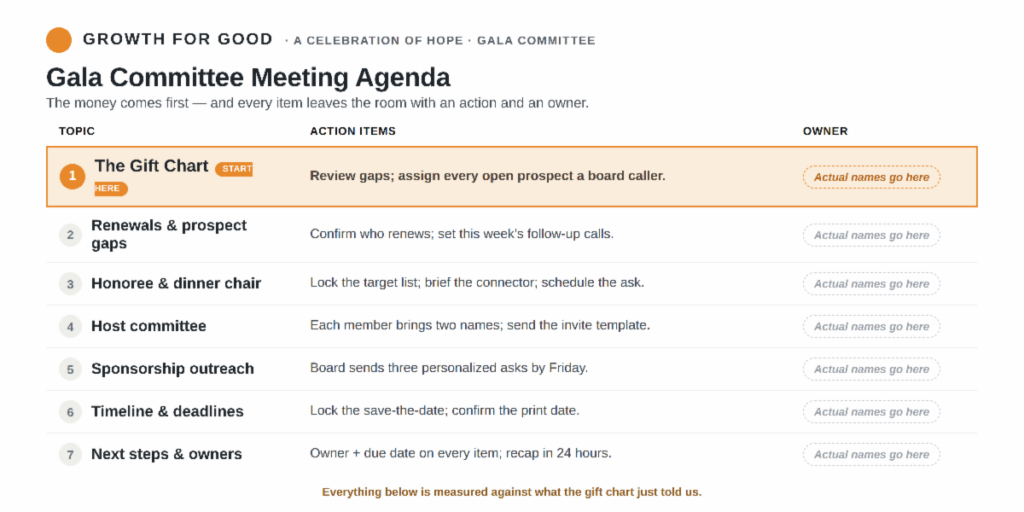
Start every single meeting with the gift chart.
Growth for Good’s gala clients will attest: we start every meeting about the gala, staff and Board conversations alike, with the gift chart. Every single one – staff and Board meetings alike. It sounds like this.
“Ok, we are 189 days out from the gala. We have secured X at the $25K level, with Y to go. Who have we reached out to? Who has not responded? What do we need to do to get a response? Have the honoree and dinner chair’s asks gone out? Where were we compared to this time last year? What’s the gap?” and so on.
Questions. Active discussion. No chatter about the tablescape or the talent. It kicks off the meeting with a series of riddles.
Hello, dopamine.
Remember, treat every gala like a data set: the final report is your benchmark for starting the next year.
Celebrate every small win.
If you have the opportunity to celebrate, take it. Every time you encourage a victory lap, the monkey brain is happy. It yearns for more wins. It comes down to brain chemistry.
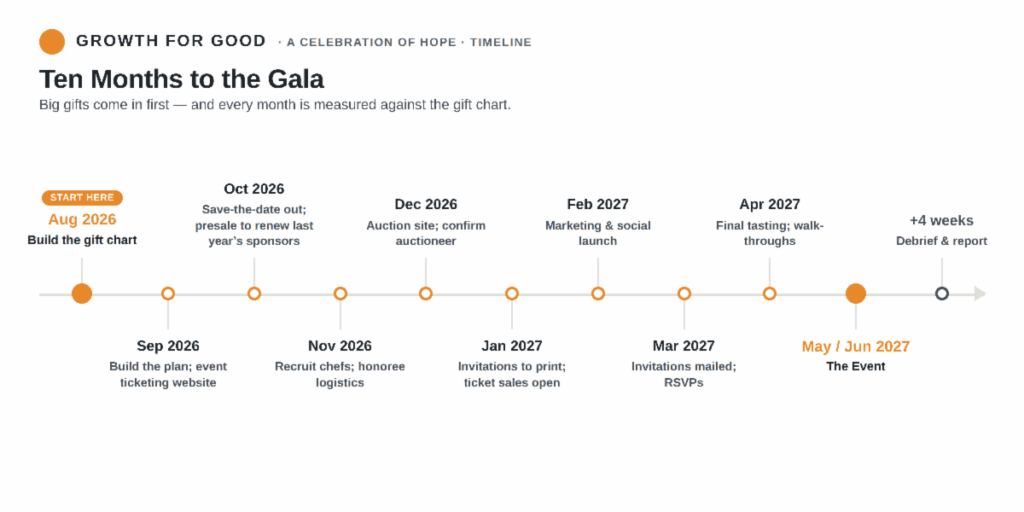
Ask for input on the timeline too.
Walk them through the runway and let them pressure-test it. When does the save-the-date go out? When must the host committee names be locked for the printed invitation? What’s in, by when?
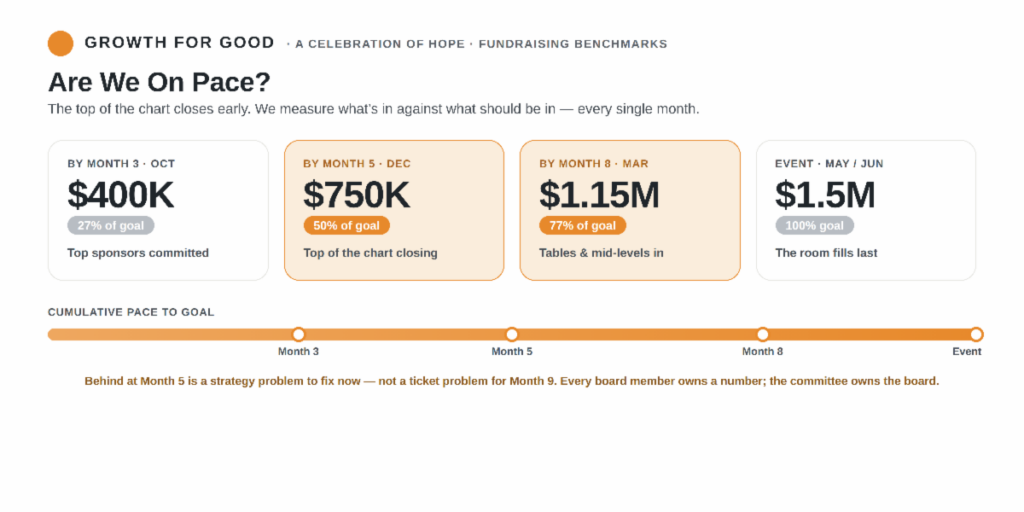
Commit to real benchmarks.
Not “we’ll try.” Actual numbers.
What’s in by month five? By month eight? What will each of us deliver — and, just as important, what will we get the rest of the Board to deliver? Because the committee isn’t the whole fundraising team. It’s the pilot. Your job isn’t only to bring in your own sponsors; it’s to get every Board member off the bench and onto the phones. Each Board member is responsible for a number. The committee is responsible for making sure they hit it.
Get all that right, and your Board is wide awake, leaning in and chasing the win.
But here’s the trap: the moment we stop handing them puzzles and start handing them the “status reports”—the slide decks, the progress updates, the mindlessly smiley “everything’s on track” presentations—we lose them. If you think a thorough report is the same thing as engagement, think again.
Neurologically, it’s the opposite.

Predictability = Snore.
Here’s the uncomfortable part. The cheerful, all-good-news gala status report — the slide deck, the “Here’s where we are, here’s what’s next, any questions?” — is, neurologically speaking, a lullaby. The culprit is one word: predictability.
The brain loves novelty. It loves uncertainty. It loves a puzzle to solve. A predictable report offers none of those things. There’s no mystery, no challenge, no reason to engage. So the brain does the sensible thing: it checks out.
This isn’t just hyperbole. In one well-known neuroscience study, researchers found that students listening to a routine college lecture showed flatter brain-wave activity than they did while they were asleep. The lecture wasn’t bad. It was simply predictable.
That’s what happens when a Board meeting becomes a parade of tidy updates. Everyone is listening politely, and almost no one is thinking. The lights are on, but nobody’s home.
Instead, replace the update with a problem.
Don’t tell the Board, “We’re 12 sponsors behind plan.”
Ask, “We’re 12 sponsors behind plan. Which names are we missing, and who in this room can help us close the gap?”
Same information. Completely different brain response.
Want to check out the science? Click HERE.
Make it effortless
None of this works if the Board’s answer is, “I’d love to help — just tell me what to do,” and you cannot deliver on the request. So remove every ounce of friction.
Do their homework. Never ask “who do you know?” Hand them three researched names, cross-checked against their own LinkedIn, and ask, “You’re connected to her — would you introduce us?” That’s a question anyone can answer.
Write every word. The honoree asks, the pre-sale letter, the stock note with a single line for them to make their own, the forward-ready save-the-date. Never send a Board member to a blank page; that’s where good intentions go to die.
Give a number they can’t misread. Not “help sell tickets” — but “buy two, sell two, forward the invitation, bring four new faces.” Something that is doable and specific, because a doable task results in a dopamine hit.
Mark the milestones. First honoree confirmed? Ring the bell. First $50,000 table? Name names. Every milestone is another hit of the good stuff — another reason the brain wires your gala to the feeling of winning.
The bottom line.
Board members don’t need more information. They need something meaningful to solve.
Once they own the puzzle, they own the outcome.
Suddenly, they’re not talking about napkin colors. They’re filling gift charts. They’re making introductions. They’re solving the problems that actually matter.
That’s not just good governance.
It’s good neuroscience.
“The Growth for Good gala approach keeps us focused on the metrics that drive fundraising, while their team handles the logistics and brings real creativity to the stage production. Five years in, we have a gala that stays mission-focused, hits its numbers, and — most importantly — is genuinely fun.”
— Carol Losos, Executive Director, GlassRoots